

Every time a leasehold flat goes up for sale, the buyer’s solicitor needs answers to a fairly standard set of questions before the sale can complete. What’s the ground rent, and when is it paid? What’s the current service charge, and when does the accounts year end? Is there a reserve fund, and what’s in it? What does the buildings insurance cover, and who’s the insurer? Are there any breaches of the lease, or planned major works? In the UK this arrives as an LPE1, the Leasehold Property Enquiry Form jointly published by ARMA, RICS and ALEP, and it lands on the desk of whoever manages the block.
The work itself isn’t hard. What’s slow is that whoever fills in this particular LPE1 has no real visibility into how the last one for this same block was answered, let alone the one before that. They pull the last set of accounts, check the insurance schedule, ask around about any works notices, and start again from a blank form. The LPE1 asks the same nine or ten questions every time, and answering it never gets any easier.
Setting the stage
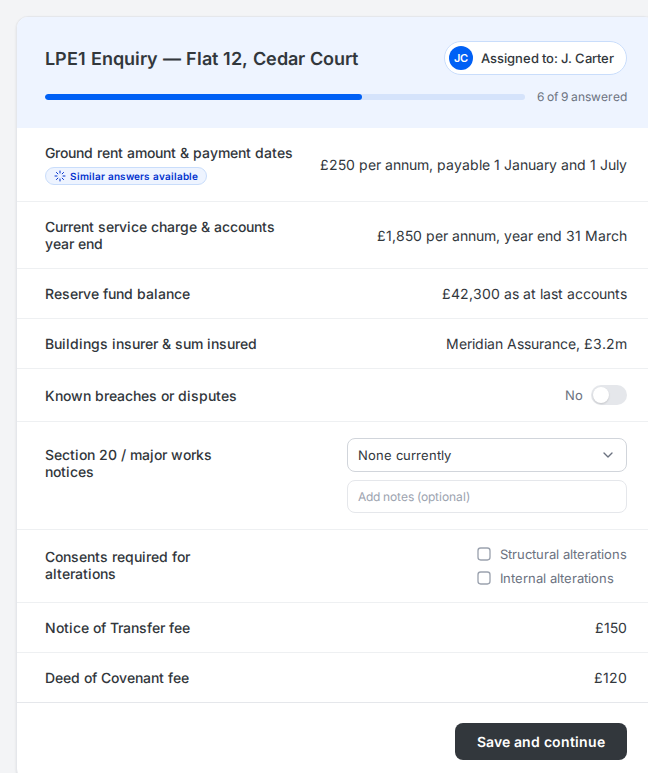
Picture a managing agent responsible for a portfolio of blocks, each with dozens of flats. Somewhere in that portfolio, a flat goes up for sale most weeks, which means an LPE1 lands most weeks too. Whoever picks it up works through the same list: ground rent and payment dates, service charge and accounts year end, reserve fund balance, buildings insurer and sum insured, any breaches or disputes, any Section 20 major works notices, consents required for alterations, and the fixed fees due back to the solicitor (notice of transfer, deed of covenant, certificate of compliance).
Almost all of that is true for every flat in the block at the same time. The ground rent terms, the service charge budget, the insurance policy, whether a Section 20 notice is currently live, none of it changes because it’s flat 14 being sold this time instead of flat 3. Only a handful of fields are specific to the flat itself: whether that particular leaseholder has any arrears, whether they’ve had consent for an alteration.
The bit that quietly stayed stuck
Even a well-run version of this process usually stops short. It’s genuinely useful to have the LPE1 generate itself from a template, get assigned to someone automatically, and get chased if it’s sitting unanswered near the solicitor’s deadline. All of that fixes the mechanics of getting a form back on time.
None of it fixes the actual slow part, which is that most of an LPE1 for this block was already answered a month ago, for a different flat in the same block, and the person filling it in this time has no easy way to see that. The service charge figure exists somewhere. The insurance schedule exists somewhere. The Section 20 notice, if there is one, was already written up somewhere. It’s just not somewhere anyone can find again without asking around or digging back through the file.
What actually fixes it
Automating the form itself only solves half the problem. The fix that matters is giving the form a memory.
An LPE1 that still asks the right questions, but isn’t filled in blind. Each block keeps its own profile, and every new enquiry still generates its own fresh LPE1, assigned automatically to whoever covers that block (with a fallback if the first choice is away, so nothing sits unanswered). What changes is what that person sees when they open it: next to each question sits the answer given the last time an LPE1 went out for this same block, so they’re confirming a figure that’s very likely still correct rather than reconstructing it from the accounts and the insurance file.
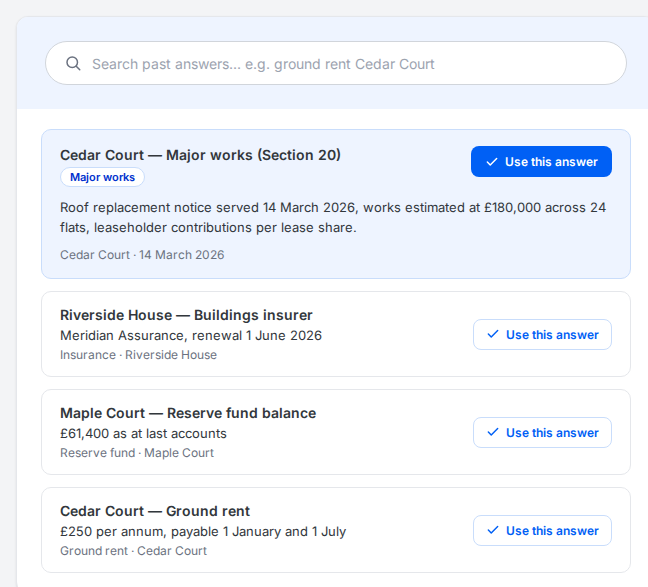
Every answer becomes part of a searchable record, not just a completed form. Once an LPE1 is sent back, its answers don’t just get filed against that one sale and forgotten. They’re indexed by block and by question, ground rent, service charge, insurer, major works, so the next enquiry on that block, or a block with a near-identical lease structure, is a search away instead of a re-derivation. A reminder still goes out if a reply is running late, but the more useful thing sitting underneath it is the growing record of what’s already been answered.
Why this compounds
The value here doesn’t show up on the first LPE1, or the tenth. It shows up on the fiftieth one answered for the same portfolio, when most fields already point straight at a documented answer from the last enquiry on that exact block. Newer staff stop needing months of picking up block-by-block knowledge before they can answer confidently. Answers get more consistent across the team too, not because everyone remembers the same block’s history, but because everyone’s looking at the same record of it.
Tip: The record doesn’t earn its place if it’s a separate system someone has to remember to go and check. It only works if it surfaces itself automatically, right inside the screen where the LPE1 question is being answered.
Final thoughts
We haven’t put a number on how much time this saves, because it depends on how much of a given block’s answers actually repeat between flats, and for most blocks, that’s most of the form. What we can say is that the shape of the fix doesn’t need to be complicated. It’s a form that already exists, an assignment step that already exists, and one more idea layered underneath both: don’t let last month’s answer disappear once this month’s form closes.
If your team handles any kind of recurring enquiry, whether that’s an LPE1, a management pack, or a similar standard set of questions that keeps coming back, and everyone answering it starts from a blank form, that’s usually not a discipline problem. It’s a missing memory.
Ready to stop answering the same questions from scratch?
If your team has a recurring enquiry form, checklist or intake process that gets filled in fresh every time, there’s a good chance most of the answers already exist somewhere. They’re just not searchable yet. We’re happy to talk through what turning that into a working record would look like for your setup.