

Since October 2025, social landlords in England have had to investigate and fix damp and mould hazards to fixed deadlines. Phase 2 is due to start on 30 November 2026, subject to Parliament approving the regulations, and the same deadlines will then apply to a much longer list of hazards.
For a lot of housing teams, the repairs themselves won’t be the hard part. They already fix broken heating and loose stair rails. The harder part is showing afterwards, case by case, that each one was handled inside the deadline.
Setting the stage
The government’s phase 2 guidance for social landlords, published in July, sets out what changes. From 30 November, Awaab’s Law is due to cover all emergency hazards except overcrowding, plus significant hazards in these categories:
- damp and mould (already covered)
- excess cold and excess heat
- falls, including on the level, on stairs and between levels
- structural collapse
- fire and explosions, except fire hazards in communal areas already covered by fire safety law, such as damaged fire doors
- electrical hazards
- domestic hygiene, including personal hygiene and food safety
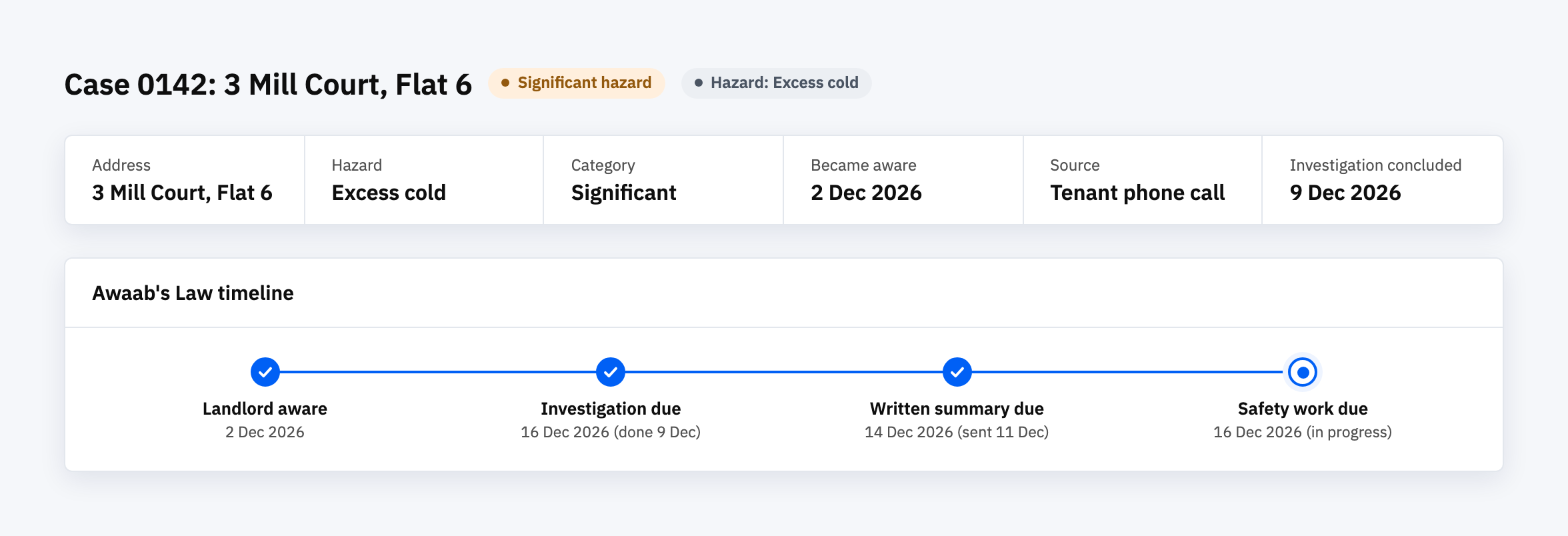
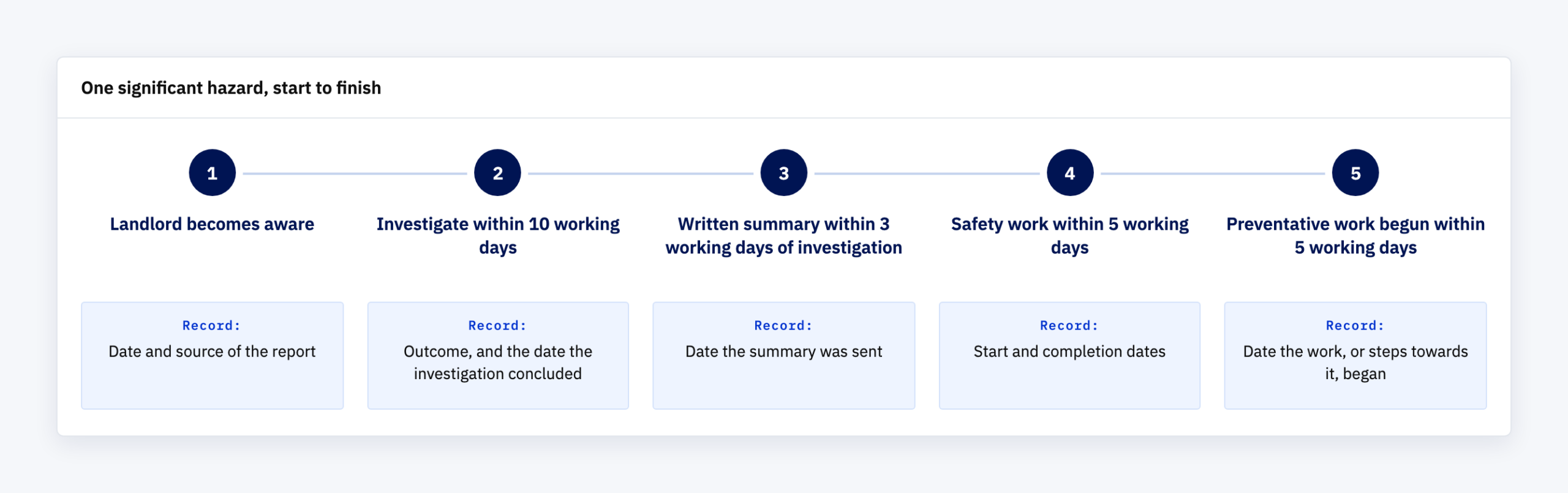
The deadlines don’t change. An emergency hazard has to be investigated and made safe within 24 hours of the landlord becoming aware of it. A potential significant hazard has to be investigated within 10 working days. The tenant gets a written summary within 3 working days of the investigation concluding. Safety work has to be done within 5 working days of the investigation concluding, and any work to stop the hazard coming back has to begin, or steps be taken to begin it, within 5 working days too.
A phase 3 is planned for the remaining hazards, again except overcrowding.
The easy fix would be the wrong one
The tempting response is to take whatever was set up for damp and mould last year (a spreadsheet or a separate log, say) and add a column for the new hazard types.
That works while the numbers are small. The trouble is that every deadline above runs from a specific date, and those dates are spread across different people. A tenant’s call, a support worker’s message, a letter from a solicitor or a neighbour’s email can each be the moment the landlord “became aware”, and the guidance says a third-party report usually counts from the day it arrives. If that date only lives in someone’s inbox, the 24-hour or 10-day clock has already started without anyone writing it down.
A log kept apart from the repairs system also drifts. The job gets closed in one place and the log still says “open”, or the other way round. Then you find out when someone asks for the history of a case.
What the record needs to hold
The guidance is direct about this. It recommends landlords “keep a record of actions taken under Awaab’s Law”, along with clear records of all engagement, investigations and communications with tenants. Read alongside the deadlines, that means each case needs:
- The date and source of awareness. Who reported it and when, including reports from third parties. The first deadline is counted from here, and the rest follow from it.
- The triage decision. Emergency, significant or out of scope, and why. The guidance asks landlords to take reasonable steps to understand the household’s circumstances, such as age, health conditions or disability, because they change how serious a hazard is.
- Access attempts. The phase 2 guidance expands its section on gaining access, including record keeping. If a tenant can’t be reached or won’t let anyone in, the attempts need to be written down.
- The investigation outcome. Whether a hazard was found, what it was, and the date the investigation concluded, since the next deadlines count from that date.
- The written summary. What was sent and when. The guidance now includes a draft template, and the summary has to say what action is needed and a target timeframe for it. If the work is finished inside those 3 days, a summary isn’t needed, but the tenant still has to be told the work is done, and the repair still goes on record.
- Safety work and preventative work. Start and completion dates for each, set against their own 5-working-day limits.
Why this matters more than it sounds
The guidance says social landlords have a defence if they have used all reasonable endeavours to comply. It gives access as an example: if a tenant is unwilling or unable to let the landlord in within the timeframes, the landlord shouldn’t be found in breach if it can show those endeavours. That is much easier with a dated note of each attempt than without one.
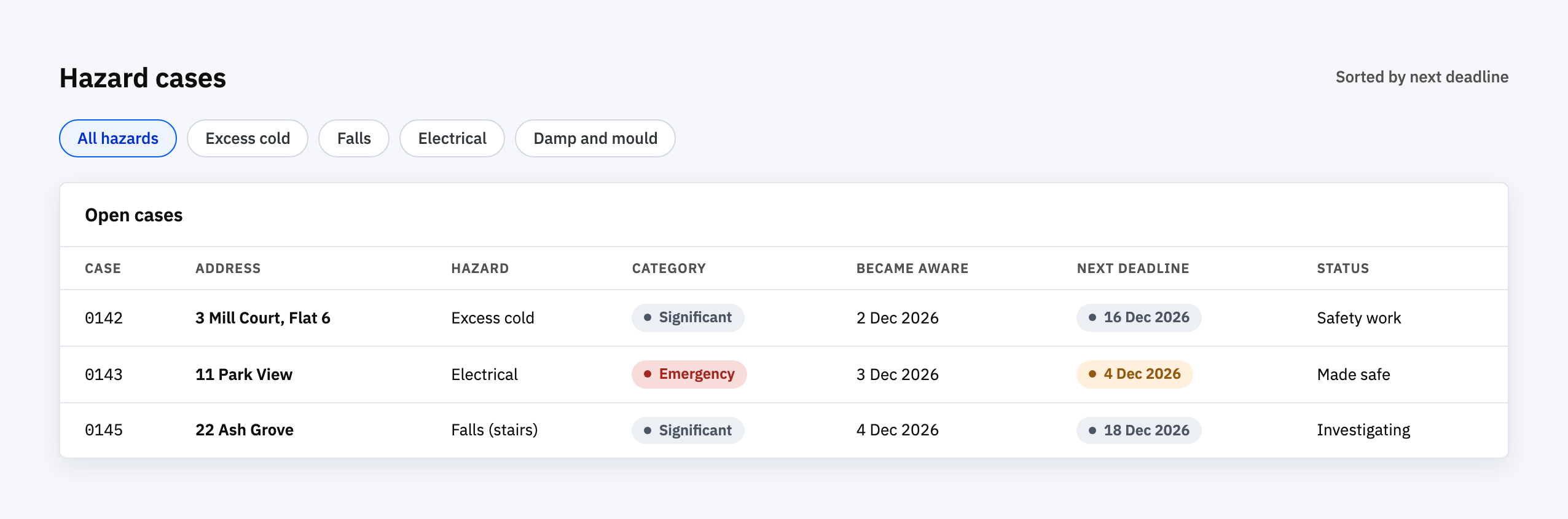
It helps day to day as well. Anyone on the team can answer “what’s due this week” without finding whoever remembers the case.
Final thoughts
Phase 2 is due in about six weeks, and phase 3 will add more hazards after that. That points towards one structure for every hazard type, with the dates the deadlines depend on captured as they happen, rather than a new log each time the list grows. For a smaller housing association, that might be a few extra fields in the system it already has. The test is simple enough: pick any open case and see whether you can tell, from the record alone, which deadline it’s on and whether it’s been met.
Ready to check your records against phase 2?
Most housing teams already do the repairs. The question for 30 November is whether the system behind them can show the timeline for each case without someone rebuilding it from emails.
This is a plain-English summary of the government’s phase 2 guidance, not legal advice. The guidance itself recommends independent legal advice if you’re unclear about your obligations.